Get The App
Take Safer Places With You
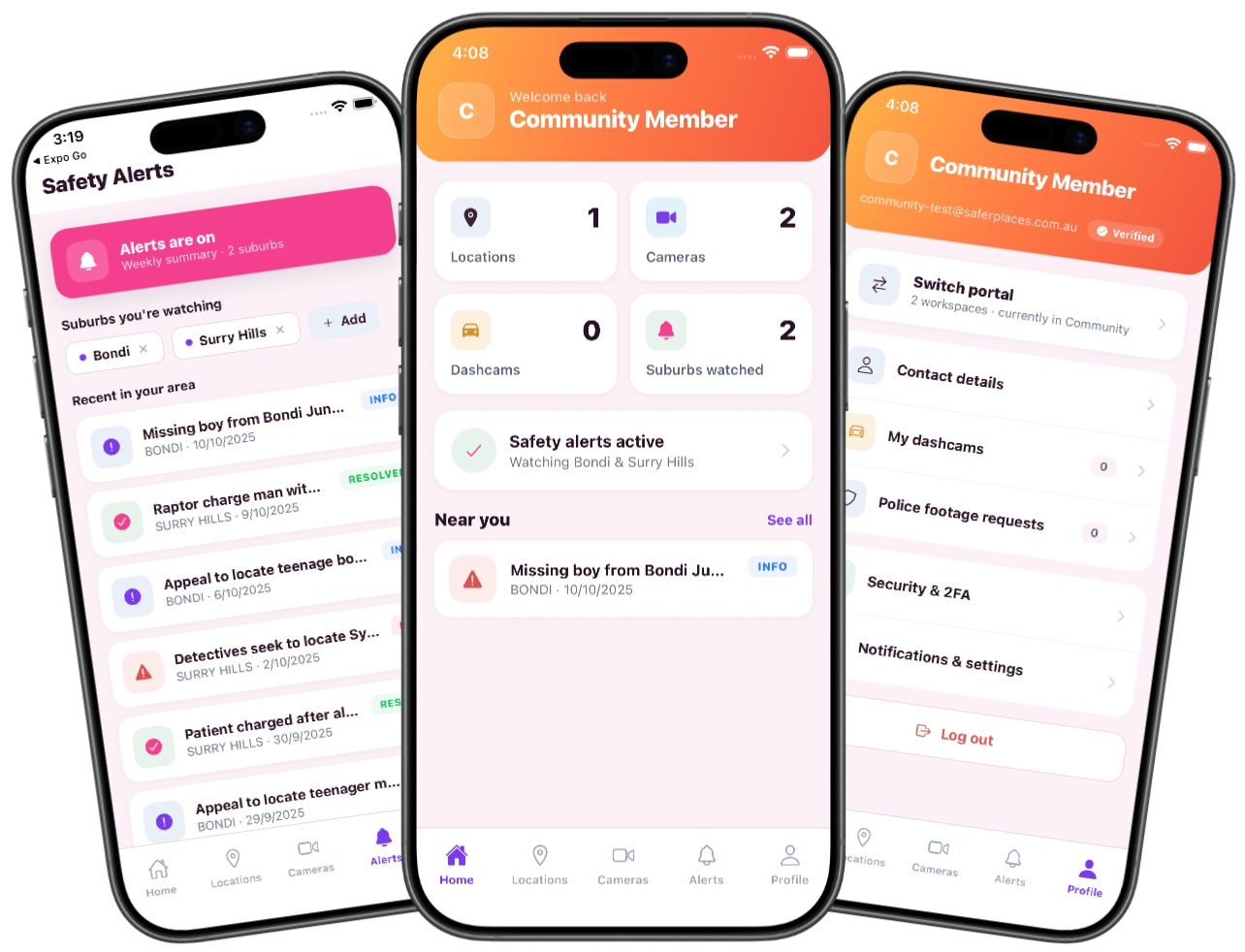
Add your contact details, register your cameras and dashcams, and get real-time local alerts, wherever you are. Available now on iOS and Android.
Whether you run fifty stores, a national logistics network, or a whole shopping precinct, Safer Places Network turns scattered cameras and siloed incident logs into one shared, searchable picture, linked directly to police.
For retail groups, franchises and large organisations running many sites, the challenge isn't any single incident, it's seeing the pattern across all of them. Safer Places gives head office one view of every store, every camera and every report.
Each site keeps its own incident log, its own camera footage and its own relationship with local police. When the same offender works a dozen of your stores, nobody at head office can see it until the losses add up.
Loss-prevention teams spend their days chasing footage across sites and formats instead of acting on intelligence.
Every site's incidents, cameras and reports in one place, with head-office visibility across the whole network.
Provision staff across sites with enterprise SSO and role-based access controls.
Spot repeat offenders and emerging patterns across regions before they spread.
Managed onboarding, training and an SLA-backed support relationship.
Fits alongside your existing loss-prevention and reporting tools. Safer Places is the intelligence layer, not another video system to run.
Roll incident data up into clean reports for leadership, insurers and police.
Industrial sites face a different threat profile: large perimeters, after-hours exposure, high-value stock and vehicles that leave the fence line every day. Safer Places extends the network across your depots and your fleet.
Cargo theft, ram-raids and after-hours break-ins happen where there are few witnesses and slow response times. Dashcam and depot footage exists, but pulling it together after an incident is slow and manual.
Hazardous materials and emergency events add a compliance burden that generic security tools ignore.
Register vehicle cameras so footage from the road can be located and shared as fast as fixed CCTV.
Track offenders and methods across depots and routes, and alert nearby sites instantly.
Coordinate incident response across large, low-staffed sites when they're most exposed.
Securely upload floor plans, chemical and dangerous-goods storage details and your red fire logbook, so fire crews and first responders know exactly what's inside, and where, before they reach the gate.
One map of every depot, yard and distribution centre across your network.
Share footage securely with police in minutes, not days, when stock or vehicles go missing.
Schools, childcare centres and campuses can securely upload their floor plans ahead of time, so that in a lockdown, security incident or worst-case active-threat scenario, police and emergency services arrive already knowing the building.
When an armed or violent threat enters a school, tactical teams can lose critical minutes tracking down administrators, locating physical blueprints and distributing floor plans. Officers are forced to clear unfamiliar, sprawling campuses blind.
Every minute without knowledge of entries, blind corners, stairwells and lockdown rooms puts both children and officers in danger.
Upload building plans and site schematics once, stored securely and only released to verified emergency services in a crisis.
In a lockdown or incident, responders and command pull up the building's layout immediately: entries, exits, lockdown zones and chokepoints.
Tactical teams map safe approaches and evacuation routes on the way to the scene, not once they're standing outside.
Register campus cameras so police can request relevant footage fast during and after an incident.
Optional, consent-based facial recognition for safeguarding situations, for example an intervention-order or banned individual. If a person on the centre's approved watchlist enters, nominated staff are alerted instantly. Deployed with a privacy-impact assessment and signage.
Sensitive site and safeguarding data stays locked down and is only surfaced to nominated staff or verified responders when it's genuinely needed.
Trader groups, chambers and precinct associations can fund or subsidise Safer Places for their members, turning scattered group chats into a single, searchable picture of who is targeting the strip.
Most precincts run on a WhatsApp group. It's quick, but the warning scrolls away in minutes, police never see it, and nothing links the offender who targeted one end of the strip to the one operating at the other.
Posting photos and accusations into an open chat is also an uncontrolled disclosure of personal information, a privacy and defamation risk for every member.
When one member logs an incident, every nearby business is notified instantly.
Link repeat offenders across the whole precinct instead of one shop at a time.
A Share button posts a clean summary into your existing chat: the habit stays, the compliance improves.
Structured, opt-in reporting with an audit trail replaces risky open-chat accusations.
Cover the whole precinct centrally, or subsidise membership as a member benefit.
Member reports and camera locations feed a picture police can actually act on.
Add your contact details, register your cameras and dashcams, and get real-time local alerts, wherever you are. Available now on iOS and Android.
Tell us about your sites, fleet or precinct and we'll design a solution, with pricing and an implementation plan, around it.
Book a Consultation